
Transformers have long played an important role in the world of electronics. No matter their size or type, transformers are crucial for balancing voltage levels between different devices, whether they’re massive transformers used in power grids or the small, customized transformers that we make here at SI Manufacturing for specialized system controls. Today, we’re going to explore exactly how a general transformer works and the basic principles behind its function.
The Purpose of a General Transformer
No matter the specific type, design, or application of a transformer, all of them perform the same basic function: a transformer takes an input alternating current, and changes the voltage of that AC current to be either higher or lower, depending on its make-up. ‘Step-Up’ transformers increase the voltage, usually for more efficient transportation of electricity, while ‘Step-Down’ transformers lower the voltage, taking high voltage inputs and making them accessible for all of our electronic devices, no matter how big or small or simple or complex.
How a Transformer Works
When an alternating current (AC) runs through a conductor, it generates a fluctuating magnetic field. Put a second conductor into the range of that magnetic field, and the fluctuations will induce a current in that additional conductor–a current that can be manipulated to produce a specific voltage.
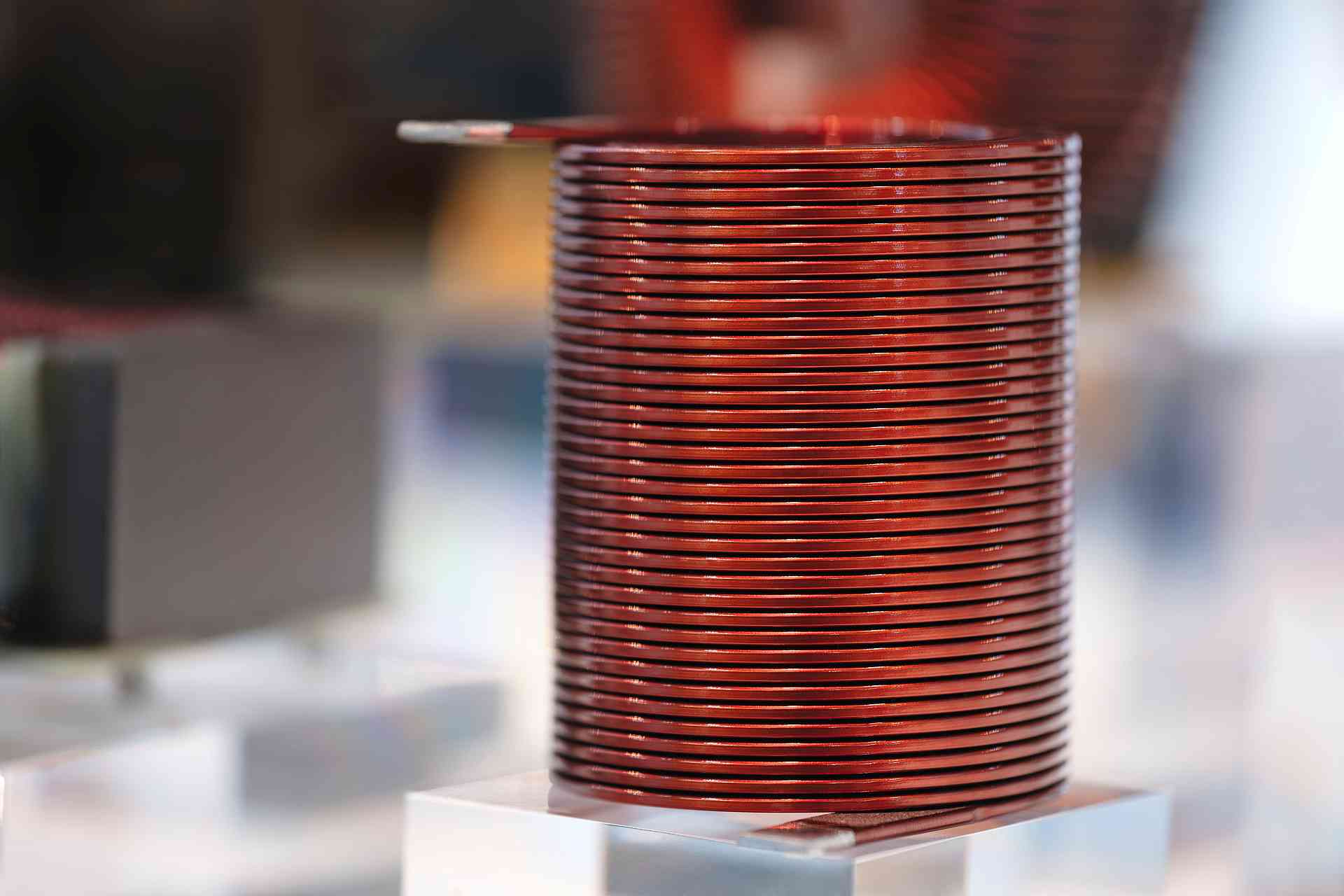
Transformers take advantage of that principle in order to control voltage levels. They consist of two conductive wire coils, primary and secondary, wrapped around a core. The AC current is introduced to the primary coil, which generates the magnetic field inducing a current in the secondary coil. That secondary coil then outputs a new voltage.
A Matter of Ratios
The actual voltage level depends heavily on the ratio of windings–how many times a wire is wrapped around the core–between the primary and secondary wire coils. If the primary coil has, for instance, 100 turns around the core, and the secondary coil has 10, then the ratio would be 10:1, a ratio that then translates to how the output voltage differs from the input. To continue with the example, if 1,000 volts were applied to the primary coil, then the secondary coil would output 10 volts.
And this works both ways too. The example above shows a step-down transformer, because it’s stepping down the voltage. Step-up transformers increase the voltage, so the secondary coil has more turns around the core than the primary. And because the ratio of turns translates exactly to the voltage ratio, transformers can be used to precisely manipulate input and output voltages.
Further Possibilities for Customization
From there, transformers can be further manipulated and made to perform certain functions. Materials, core shape, coil windings, and more all contribute to the efficiency of the transformer and the precision of its functionality. There are plenty of ways that manufacturers can–and have–innovated on the general transformer for more complex applications and systems.
About SI Manufacturing
SI Manufacturing is a full-service electronics manufacturing company specializing in custom magnetics, power supplies, and systems for some of the most demanding industries in the world. If you’re interested in working with us, give us a call! We’d be happy to learn more about your next project and how we can help.